This lesson has two gears. Core = what you MUST know to start today. Mastery = the deeper "why" for when you're ready. Beginners: do Core first.
Why this matters
One candle is a frame. Meaning lives in the sequence — what the next candle does with the last one's promise.
In Lesson 1 you learned a candle is a promise: a strong close says "more should follow tomorrow." Lesson 2 is where that promise gets tested. Two or three candles, read together, tell you only one of two stories: the story continues, or the story flips. Everything you'll ever trade is one of these two.
Core Mode
Everyone starts here
Fluxus: "Bullish needs bullish follow-through. So does bearish. A small move only tells you one thing — somebody bought, or somebody covered."
Fluxus: "That's not a forecast. That's hope wearing a forecast's clothes."
L2.1Two stories: continuation or reversal
Read 2–3 candles as one short conversation. Ask the Lesson-1 questions again — who won, how hard — but now across the sequence: is the same side still winning, or did control change hands?
There are exactly two outcomes:
① Continuation — the promise is kept A strong candle, then a shallow pause (small body that gives back little), then another push the same direction. The winner rested and kept going.
- Tell: the pause candle does not erase the strong candle. Control never left.
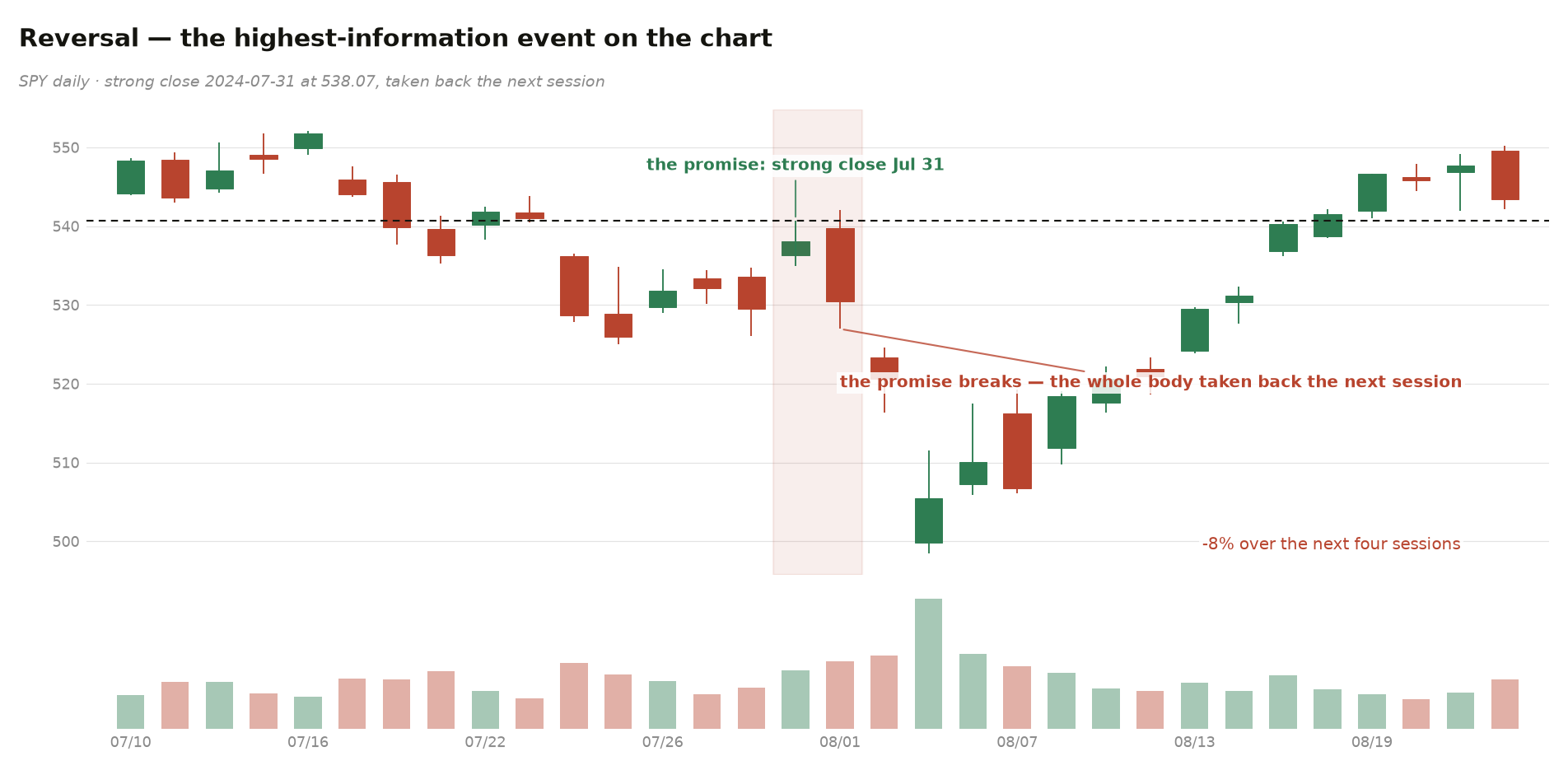
② Reversal — the promise is broken A strong candle, then the next candle closes hard the other way and erases it (the classic engulfing). Control changed hands.
- Tell: candle 2's body swallows candle 1's body in the opposite direction.
Continuation = expectation kept. Reversal = expectation FAILED. That's the whole game, and expectation failure is the more valuable of the two.
One trap to kill now
Don't trade candle 1 before candle 2 confirms. A strong candle tempts you to jump in (FOMO). The combo isn't a combo until the second candle closes. Wait for the sequence.
L2.2The Core Drill
Combo Read-Aloud Drill
- Daily chart, indicators off. Slide a 2-candle window across the chart.
- At each pair, say out loud: "Continuation — promise kept." / "Reversal — promise broken." / "No combo — wait."
- Start at 15 combos a day, work up to 30 — for 5 days. Then check what happened on the candle after — were you reading the handoff, or guessing?
Mastery Mode
Come back when Core is reflex
L2.3The expectation-failure playbook
This is the spine of the whole course, so slow down here.
Step 1 — Set the expectation. A strong candle 1 sets a testable expectation: "tomorrow should follow through."
Step 2 — Watch it get tested. Candle 2/3 either confirms or violates it.
Step 3 — Act on the FAILURE, because failure is information. When a well-set expectation fails, a crowd is now trapped on the wrong side — they must exit, and their exits fuel the move against them.
| Situation | What it means | What to DO |
|---|---|---|
| Expectation kept | Trend intact | Stay / add with the trend |
| Expectation failed and you're IN | You're on the wrong side | Exit. The trade is over. No reversal, no flip-flop. |
| Expectation failed and you're OUT | A crowd just got trapped | It may set up a fresh, separately-judged trade later (→ Lesson 4) — never an emotional reverse of the one you just exited |
Flight-manual directive (locked): if you are already IN and the expectation fails → you EXIT. The trade is over. You do not reverse. You do not flip-flop. Getting out cleanly is the entire job. The opposite trade, if one ever exists, is a separate decision on a separate day — not a reflex to being wrong.
L2.4It's a game — read the handoff
Zoom past "who won each candle" to how control is being handed off. Two tells:
- Absorption — a big candle into resistance (a price level where sellers keep showing up) but the next candle can't follow through: someone is absorbing all the buying. Supply (want-to-sell orders) is winning quietly.
- Exhaustion — each push travels less distance than the last: the winning side is running out of ammo.
L2.5Kill bar & mother bar — the two big candles
Before you sort combos into families, scan any chart for its biggest bars — range dwarfing the neighbours, volume heavy. They come in two roles, and the two are not the same thing:
The KILL BAR is a big DOWN bar that ends an advance. Heavy volume, a range that dwarfs its neighbours, a close pinned near the low, printed against a rising tape — a large seller just terminated the old story. You will meet it at tops as distribution's exclamation mark (L5.3), and mid-decline as capitulation's voice. Read it as: the advance is dead until proven otherwise.
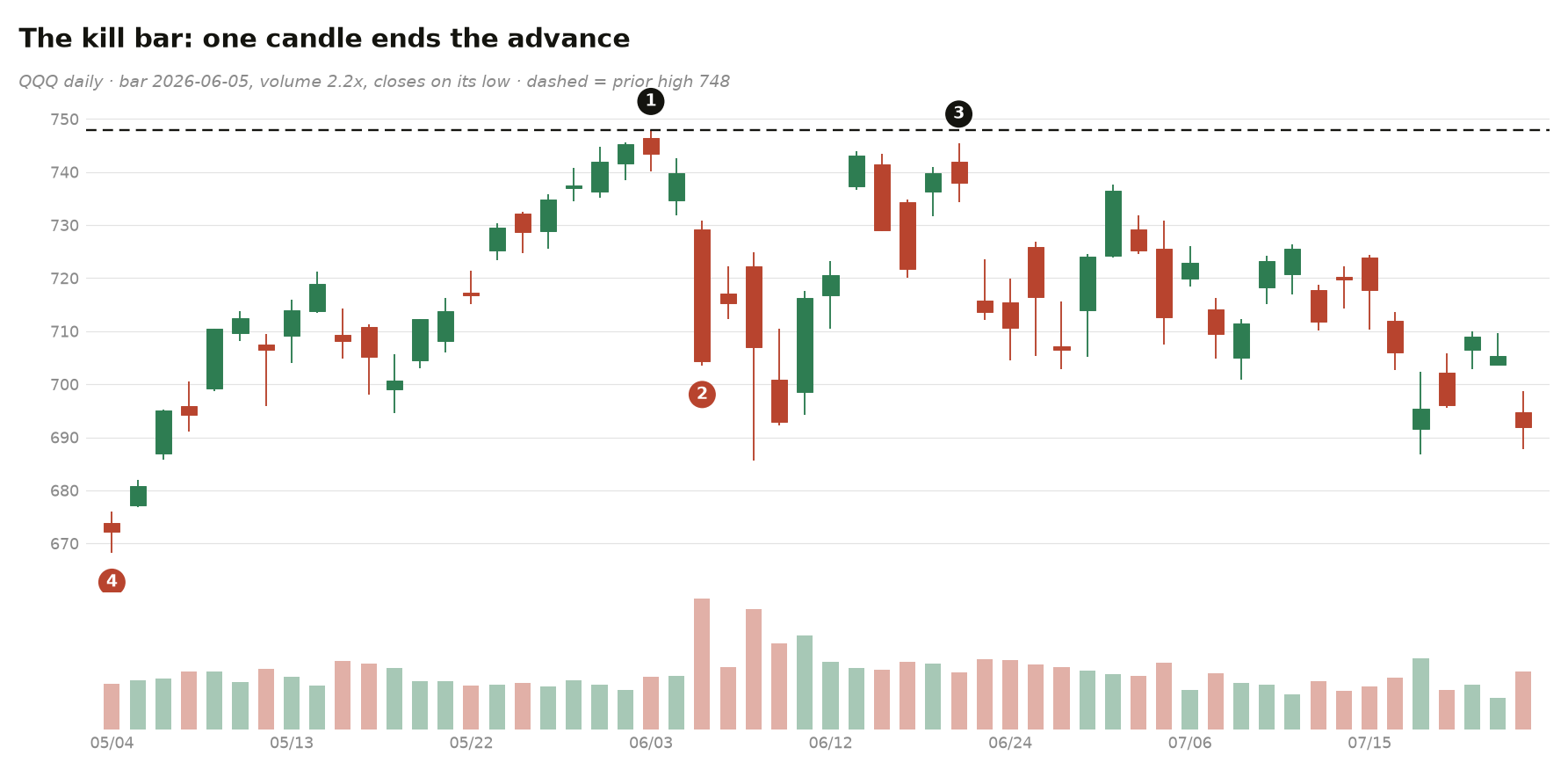
① the last high · ② the kill bar — heavy volume, closes on its low · ③ the bounce dies inside the bar's range: the old story never comes back · ④ the low, two months on
What defines each — size, speed, or volume? A kill bar is defined by direction (down, against an advance), magnitude and close location; volume is the witness — a huge red bar on thin volume may just be a liquidity vacuum. A mother bar is defined by what happens afterwards: containment, nothing else. Speed matters to neither definition — it only tells you how urgent the crowd was.
The MOTHER BAR contains what follows — and it has NO direction. When the bars after a big candle stack inside its range, that candle is the mother bar: its range is the battlefield, its far end the invalidation. Up or down does not enter the definition — only containment does. The violent UP bar that launches moves — the kill bar's mirror — already has a name from L11's gap taxonomy: the breakaway bar. NVDA below was a breakaway bar that then spent a month as the mother bar.
One question everyone asks: isn't the mother bar usually green? Often, in this course — because the ones worth trading are mostly breakaway bars that then hold their own range. That is sample bias, not definition. The definition has no direction; your watchlist does.
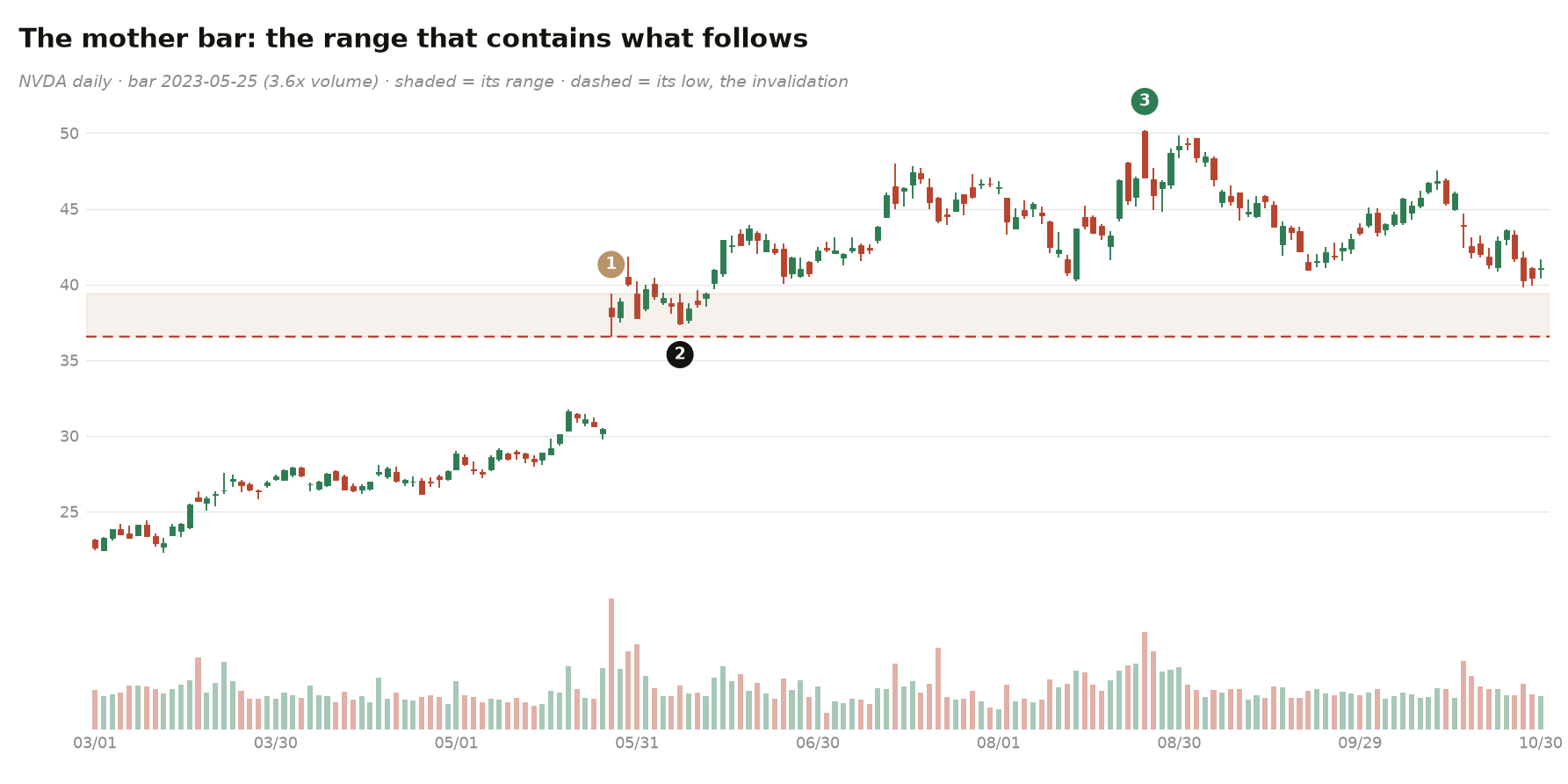
① the mother bar (a 3.6x-volume breakaway bar) · ② the retest goes INSIDE the bar — normal · ③ its low never trades, the trend runs on
L2.6Two families of combo — momentum & reversal
Every combo you'll ever see sorts into one of two families (plus a neutral "pause"). Learn the two families, not the fifty names.
Momentum / Continuation (promise kept)
The winner keeps winning — bet with the move.
| Combo | What you see | Reading |
|---|---|---|
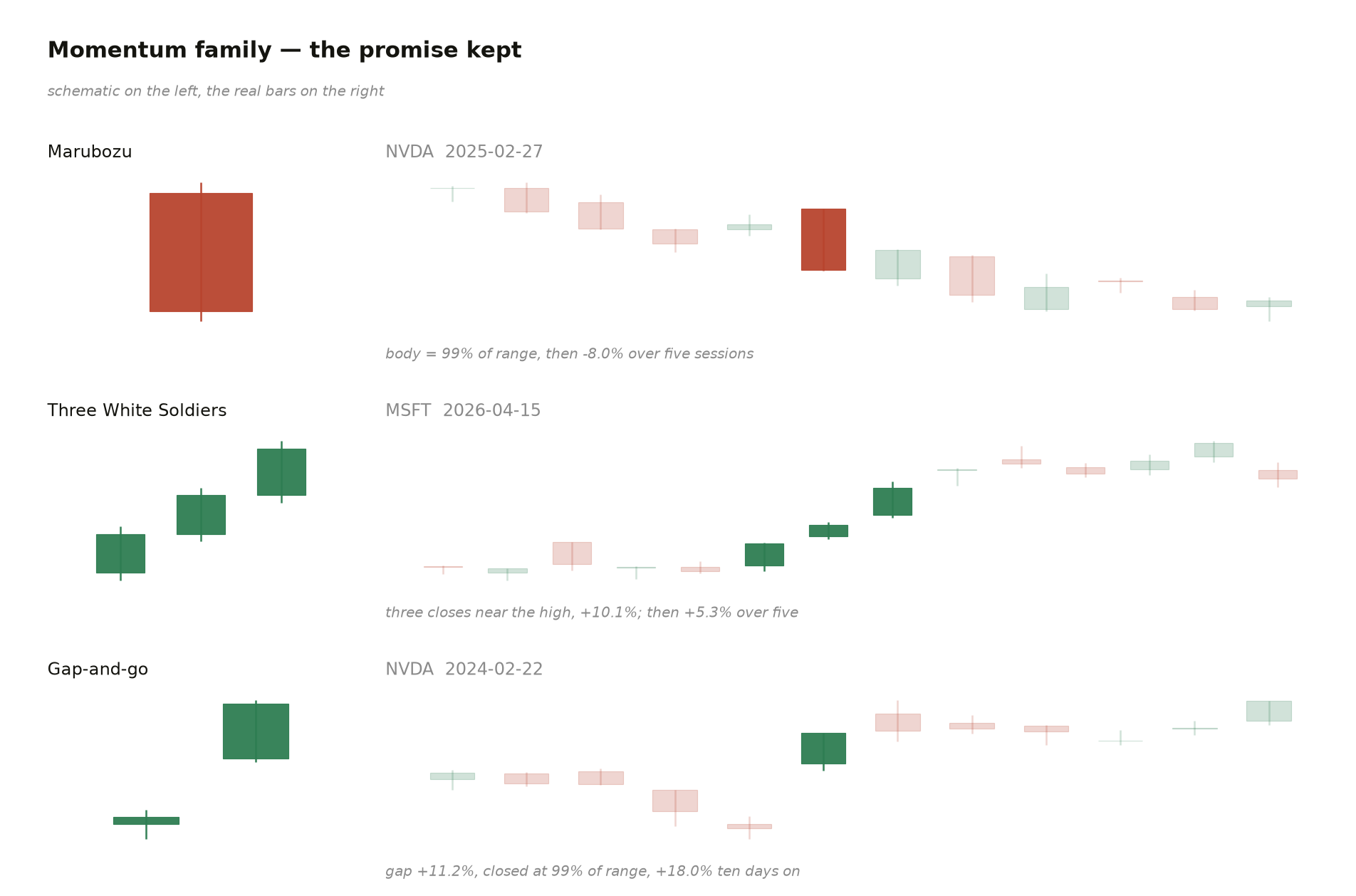
| Marubozu | one big full-body candle, ~no wicks | pure one-side momentum |
| Three White Soldiers | 3 strong up candles, each closing near its high | strong up thrust |
| Three Black Crows | 3 strong down candles, each closing near its low | strong down thrust |
| Rising · Falling Three Methods | big candle → tiny counter-pause candles → continue same way | trend resumes after a rest |
| Gap-and-go | a gap in the trend direction that holds and extends | momentum accelerating |
Reversal (promise broken = expectation failure)
Control flips — a crowd just got trapped.
| Combo | What you see | Reading |
|---|---|---|
| Engulfing | candle 2's body swallows candle 1, opposite way | control flipped |
| Outside bar | candle 2 engulfs candle 1's full range | violent flip |
| Morning · Evening Star | strong → tiny pause candle → strong opposite | 3-candle reversal |
| Tweezer top/bottom | two candles share an almost identical high/low | rejection at one level |
| Piercing · Dark Cloud | candle 2 closes back past candle 1's midpoint | partial reversal (softer engulfing) |
| Hammer · Shooting star | small body + one long rejection wick (from L1) | single-bar reversal tail |
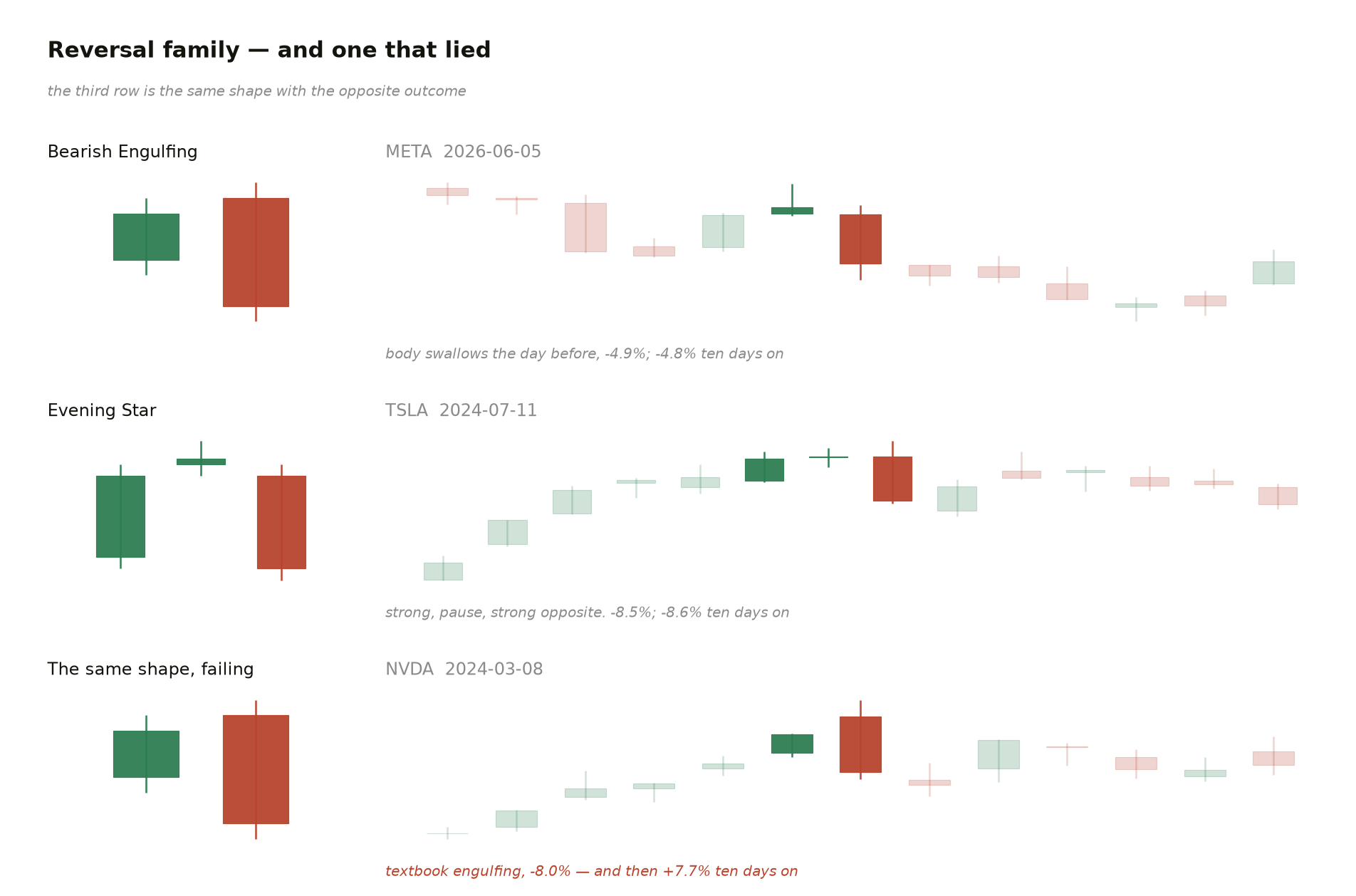
Look at the third row before you go on. Both prints — NVDA's 2024-03-08 and META's 2026-06-05 — are textbook bearish engulfings. One was followed by −4.8%, the other by +7.7%. The shape did not decide it; where it happened did — which is exactly what L2.7 is about.
Pause (not yet committed)
| Combo | What you see | Reading |
|---|---|---|
| Harami · Inside bar | candle 2 sits inside candle 1 | a rest that can load into compression (→ Lesson 3) |
Filing tabs, not a zoo: momentum-continuation, reversal, or pause — pick one. If a name won't sort into a family, drop it.
L2.7Same combo, different phase
In a trend, bet on continuation combos and treat reversals as suspects until proven. In a range, reversal combos at the edges of the range are the high-value reads. Phase decides which combo to trust.
Trend and range are the two easy phases. Two more decide most of the damage a beginner takes.
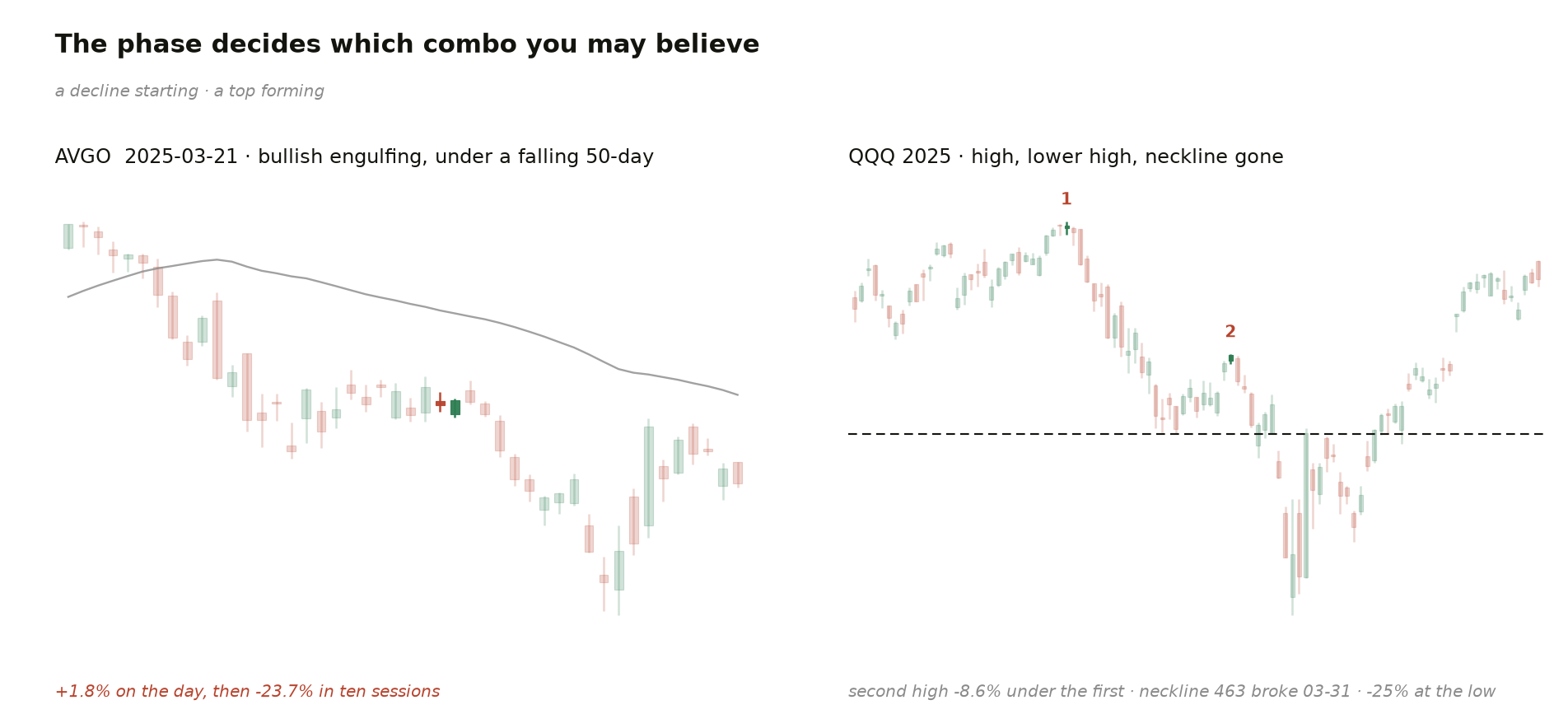
③ A decline just starting Here every bullish reversal combo is a suspect and the continuation combos pointing down are the honest ones. The tell is not the candle — it is the 50-day moving average sloping down underneath it. AVGO printed a clean bullish engulfing on 2025-03-21 with the 50-day falling overhead. The candle was perfect. Ten sessions later the stock was 23.7% lower.
④ A top being built A top is not one candle, it is a sequence: a high, then a high that fails to exceed it, then the low between them giving way. QQQ built exactly that in early 2025 — 2025-02-19 high, 2025-03-25 high 8.6% lower, neckline 463 gone on 03-31, and −25% at the worst of it. In this phase reversal combos at the highs are the high-value read, because each one is a piece of evidence in the sequence.
The rule that covers all four: a combo is a sentence; the phase is the paragraph it sits in. The same sentence means different things in different paragraphs.
L2.8The Mastery Drill
Expectation Journal
- Pick 30 combos across at least 8 different stocks — and before looking right, write two things: the expectation the combo set, and which of the four phases it sits in (trend / range / decline starting / top forming). The phase must be decided from what is left of the chart, not from what happened next.
- Reveal 10 sessions. Tag each as kept · failed · failed-then-reversed, and record the follow-through in percent. Note the volume on the decisive candle.
- Now score yourself by phase, not overall. Build this table from your own 30 — the numbers are what you're after, not the anecdotes:
| Phase | Continuation combos kept | Reversal combos kept |
|---|---|---|
| Trend | ||
| Range | ||
| Decline starting | ||
| Top forming |
The pass bar in the trend row, your continuation number must beat your reversal number. In the top-forming row it must be the other way round. If your table doesn't show that split, you are still reading shapes and not locations — do another 30 before you trade any of this.
- The drill that actually hurts Go back to the two engulfings in the figure above — NVDA's 2024-03-08 print and META's 2026-06-05 print. Cover the right side of both. Write down, from the left side alone, which one you would have trusted and why. Most people cannot separate them, and that is the honest result: the shape carries almost no information; the location carries nearly all of it. Keep the note. Re-read it the next time a candle makes you feel certain.
Beginner Traps
1. Jumping candle 1. The single strongest temptation. The combo isn't real until candle 2 closes. (Epilogue trap #2 lives here.) 2. Forcing a reversal call in a strong trend. In a one-way uptrend, most "reversals" are just pauses. Respect the phase. 3. Ignoring a failure because you like your position. A failed expectation is an exit, not a suggestion. Refusing to see it = the bottom-fishing self-harm mindset — buying because it "looks cheap" while it's still falling.
TL;DR
- Core: read 2–3 candles as one conversation → continuation (promise kept) or reversal (promise broken). Wait for candle 2.
- Mastery: expectation failure is the most valuable signal — a trapped crowd must exit; read absorption/exhaustion for the handoff; trust combos by phase.
Extended Reading (optional)
Not required. Skip until Core is reflex.
- Multi-timeframe combos — one daily combo = many hourly combos. The lower timeframe shows you the handoff happening.
- Order-flow absorption/exhaustion — footprint charts show the absorbing hand inside the combo.
- Al Brooks price action — an extreme deep-dive on bar-by-bar reading (advanced, optional).