This lesson has two gears. Core = what you MUST know to start today. Mastery = the deeper "why" for when you're ready. Beginners: do Core first.
Why this matters
A market that stops moving is not dying. It is loading.
Fluxus: "The longer the base, the higher it goes. SMIC sat for five months with the 10, 20 and 50 glued together — a compressed spring. Then it broke, and it went."
Fluxus: "No tightness, no trade."
Module 1 note: You are still only training your eye here — learning to SEE this on a naked chart. No real trades yet. Exact entries, stops, and sizing come in Module 2 (Lessons 10-14). For now: recognize, drill, repeat.
In Lesson 2 you saw pauses inside a trend. Take a pause to its extreme — candles shrinking, ranges overlapping, volume drying up — and you get compression: a coiled spring. The single most reliable thing in markets is that quiet leads to loud: tight, boring, low-volatility ranges resolve into fast, explosive moves. Almost every swing setup (a chart pattern that qualifies for a trade) you'll ever take — breakout, flag, VCP (Volatility Contraction Pattern) — is buying the release of a compressed spring.
Core Mode
Everyone starts here
L3.1Quiet loads the spring
Compression = a spring loading. Expansion = the spring released. Your whole job in this lesson is to spot the loading and wait for the release.
Three tells that a spring is loading:
- Candles shrink. Each bar's range gets smaller than the last.
- Ranges overlap. Price coils sideways instead of trending; bars sit on top of each other.
- Volume dries up. Fewer and fewer participants — the calm before the move.
The tighter and quieter it gets, the bigger the eventual move. Boredom is the setup.
One trap to kill now
Do not guess direction inside the coil. A spring can fire up or down. You are not paid to predict the release inside the compression — you are paid to react to the release. Wait for the expansion candle.
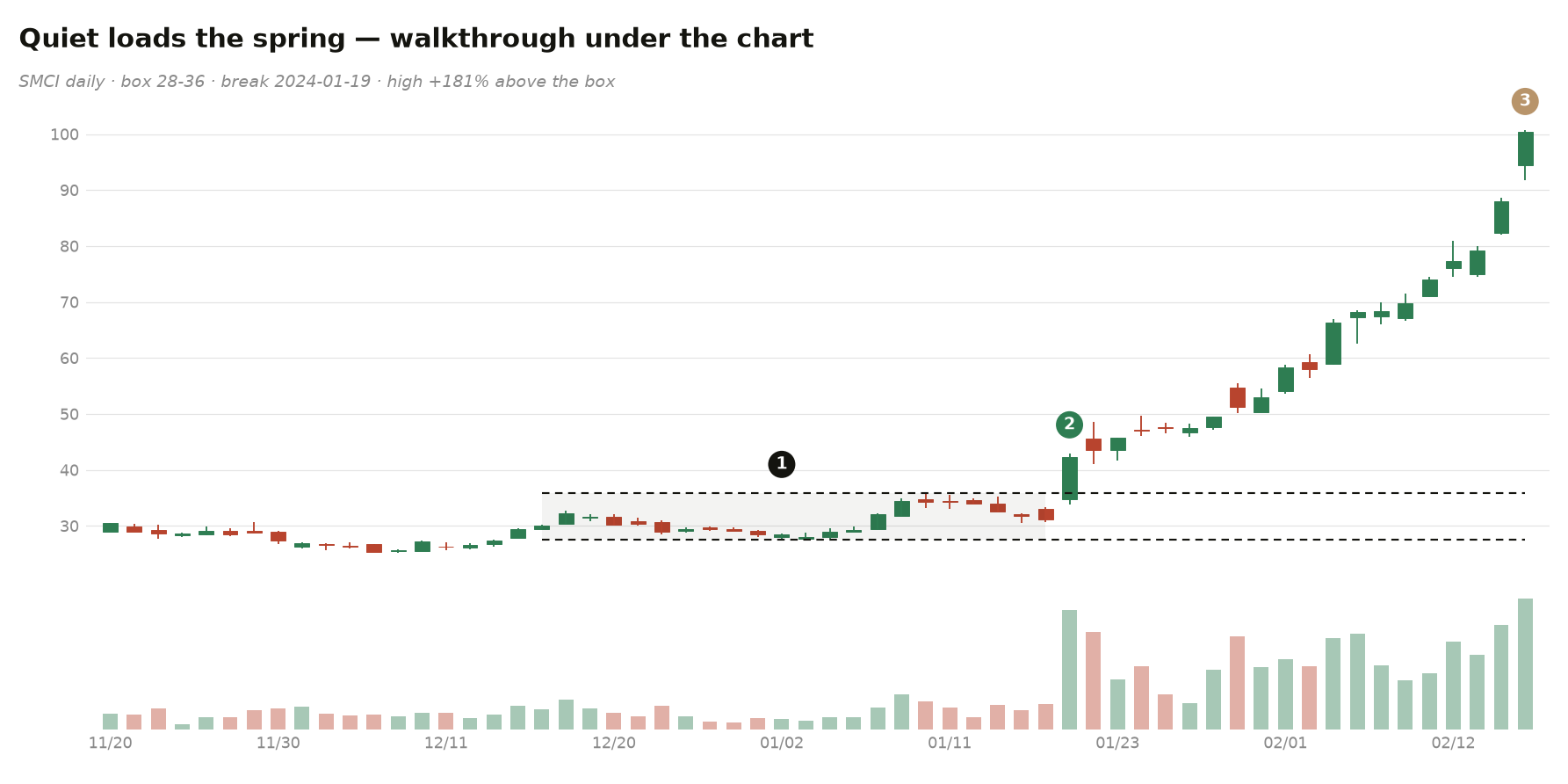
① the coil — range contracting, volume drying · ② the release · ③ the high that follows
Two cases, one default. A coil that forms inside an uptrend usually resolves with the trend — consolidation is the trend catching its breath, and the break inherits its direction. The exception — a break against the trend, or one that fails back into the coil — is rarer and more violent, and it gets its own treatment: the failed break later in this lesson, and the shakeout in L4.
And one more law: the bigger the base, the higher in space. The longer and larger the coil, the more disagreement it stores — and the further the release travels when it finally lets go. The extreme case makes the point better than any rule:
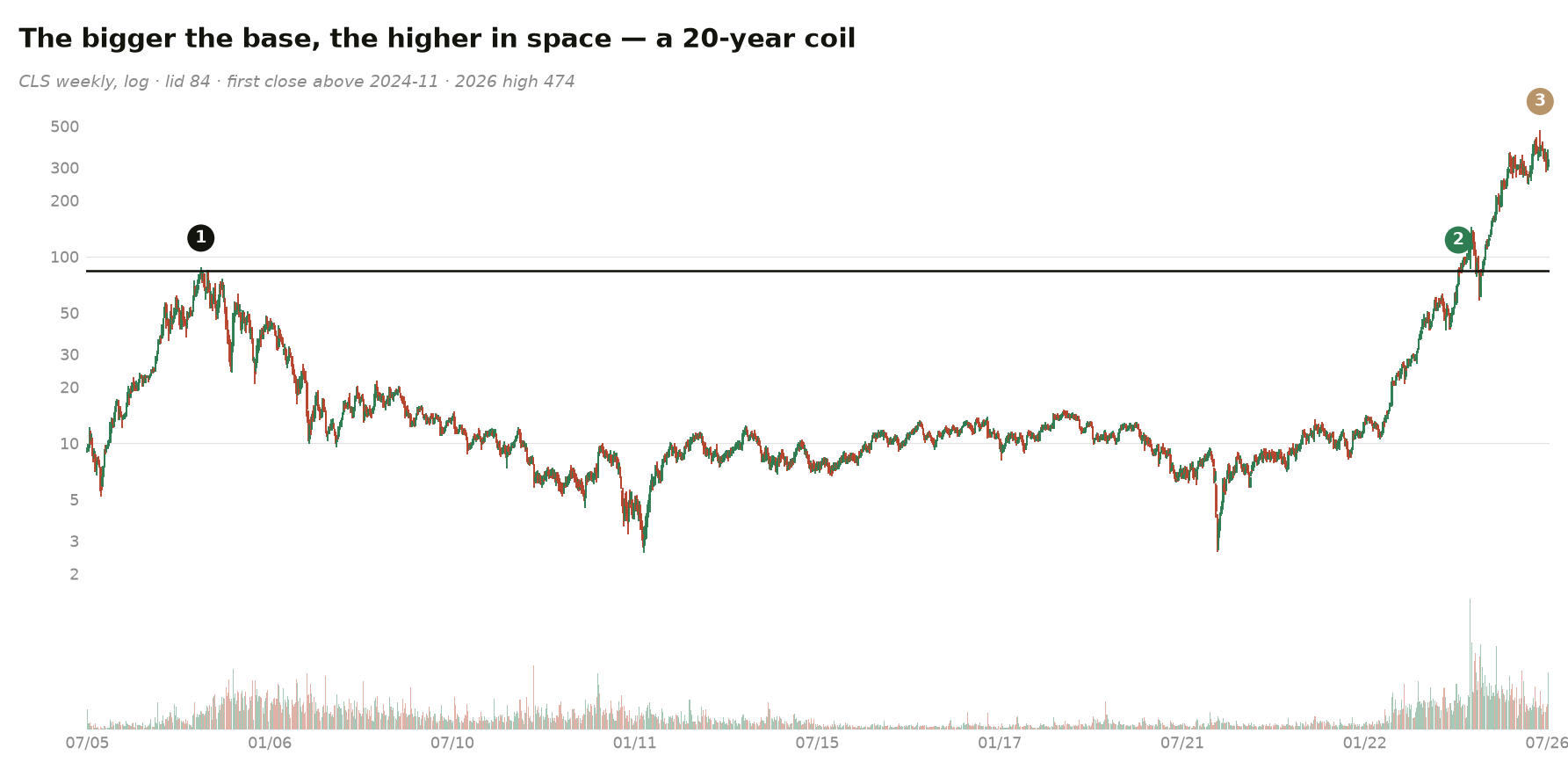
① the 2000 high · ② the first weekly close above the lid, two decades later · ③ the 2026 high
L3.2Expansion lies about direction — two traps you must know
The default: a coil inside a trend resolves WITH the trend. The two cases below are the exceptions — and both are tradable once you know their shape.
Trap 1 — the coil in a downtrend. Price pauses, tightens, then pushes UP — and the push gets sold hard, starting a second leg down. In a downtrend the deceptive direction is up: rallies are where trapped holders finally get out, and where shorts reload.
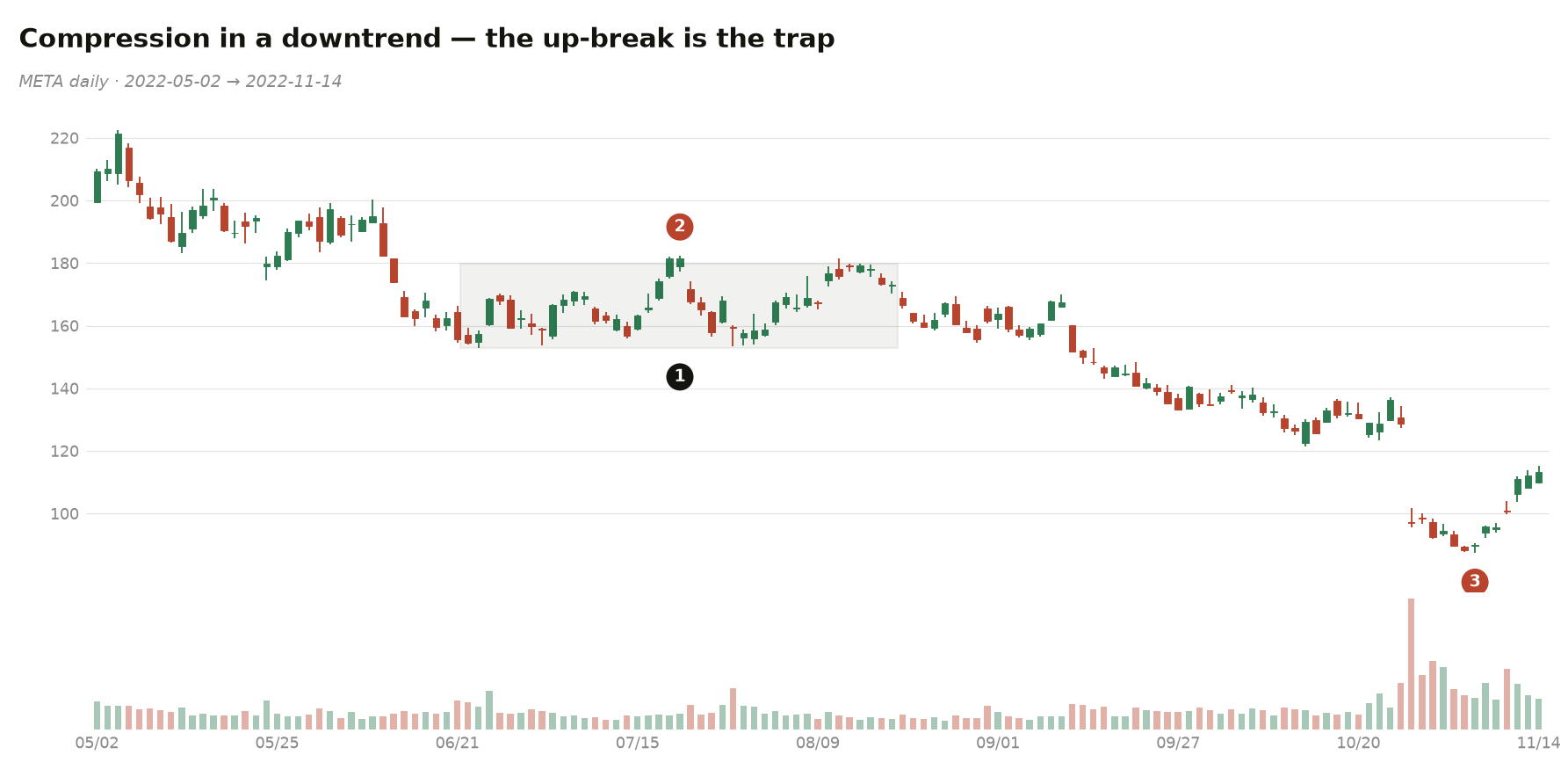
① the pause inside a downtrend · ② the up-move gets sold · ③ the second leg down
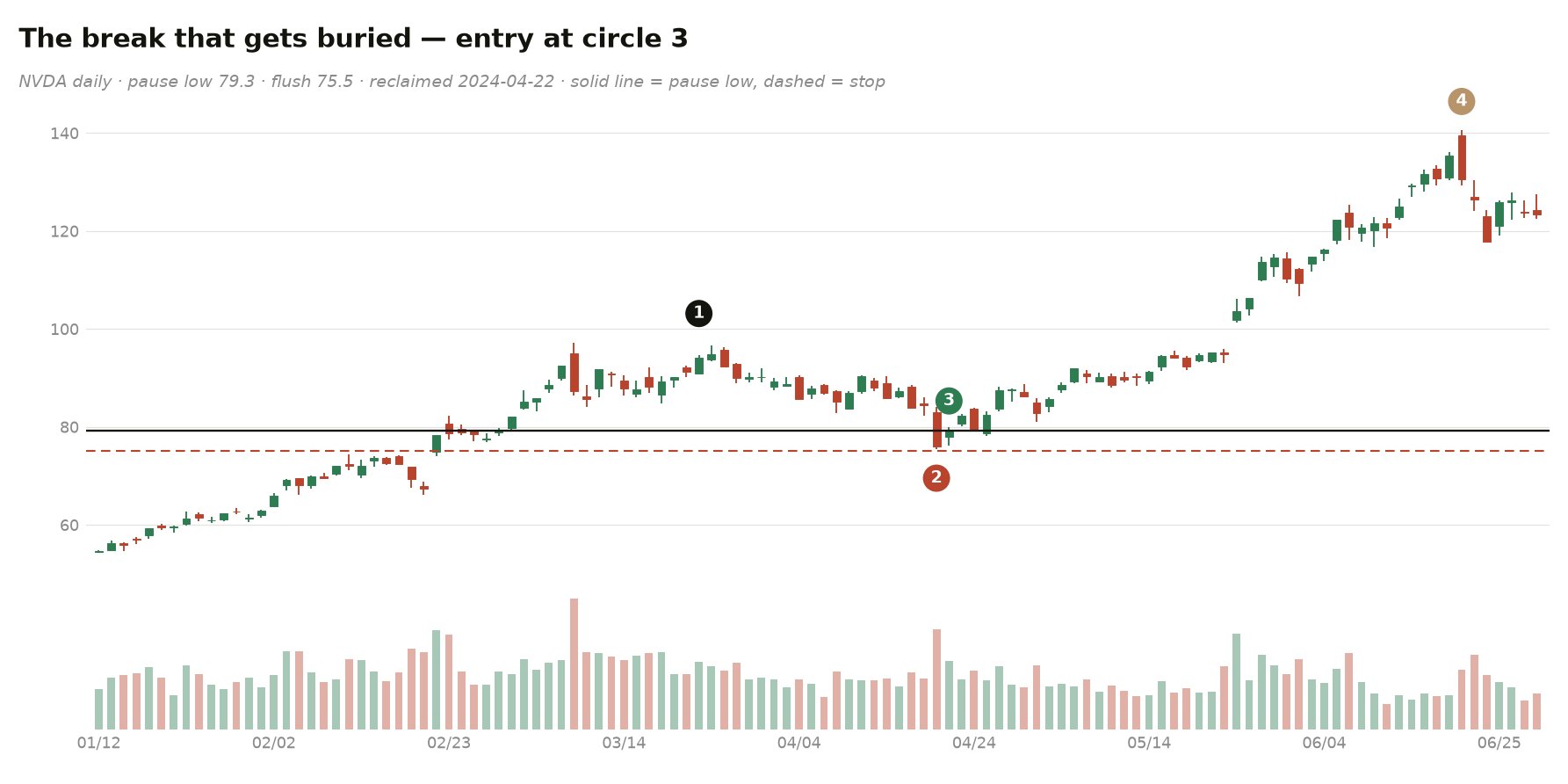
Trap 2 — the fast break DOWN that gets buried. In an UPTREND, a slow pause suddenly breaks downward — violently — and is buried just as fast by the trend. That flush is not the coil failing; it is bigger timeframes boarding: shares pass from short holding periods to long ones, and the snap-back is the pullback entry.
L3.3The Core Drill
Coil-Spotting Drill
- Daily charts, indicators off (volume on for this one). Scroll through names.
- Every time you see candles shrinking + overlapping + volume fading, circle it and say out loud: "Spring loading."
- Then scroll forward and check: did it expand? Which way, and did volume come back on the release?
- Start at 10 coils a day, work up to 20 — for 5 days. You're training your eye to find quiet before it gets loud.
Mastery Mode
Come back when Core is reflex
L3.4Why compression works — volatility is mean-reverting
Volatility cycles. Low volatility begets high volatility and vice versa — it does not stay low forever. A quiet range is not a new permanent state; it is the tension part of a cycle that must resolve. That's the physics under every breakout.
That is a claim, so here is the measurement. 18 large, liquid US names, 46,764 sessions, 2015 to 2026. For every session we ranked the 20-day ATR as a percentage of price against that stock's own previous year, then looked at what the next 20 sessions did to it:
| Where today's volatility sits | Next 20 sessions, median change | Share that expand |
|---|---|---|
| Quietest 10% | +12.9% | 72.3% |
| 10-25% | +5.7% | 60.1% |
| 25-50% | −0.2% | 49.8% |
| 50-75% | −5.7% | 40.5% |
| 75-90% | −12.8% | 32.7% |
| Noisiest 10% | −18.6% | 26.0% |
The ladder does not reverse once. Quiet reliably becomes loud, loud reliably becomes quiet, and everything in between sits on the line. This is the closest thing to a law that this course will show you.
Now the two things the table also says, which matter more than the headline. First: the quietest decile expands 72% of the time — so 28% of the time a tight base just gets tighter. That number is the entire reason this lesson tells you to trade the release and not the coil; anticipating the break means volunteering for that 28%. Second, and bigger: not one column here says anything about direction. Compression tells you a move is coming. It does not tell you which way. Anyone who tells you a coil is bullish is reading something that is not in the data.
L3.5Volume is the fuel gauge
- During compression: volume should dry up — supply is exhausting, sellers are done dumping.
- On expansion: volume should surge — real demand arriving to fuel the move.
- A breakout on no volume is a suspect — often a fake-out that fails back into the coil.
The nine-cell grid. The Chinese volume-price tradition (Ling Bo's Liang Jia Shi Kong is the cleanest modern statement) crosses price direction with volume direction — nine combinations. You don't need all nine; inside a range, three cells do the work:
| Cell | Reading |
|---|---|
| Flat price, shrinking volume | Everyone willing to trade has traded — the coil is reaching its end. |
| Flat price, growing volume, at lows | Someone is quietly collecting shares inside the box. |
| Flat price, growing volume, at highs | High-turnover churn that can't lift price — the "long sideways ends down" trap. |
Same physics as this lesson's fuel gauge — the grid just gives each state a name.
L3.6Expectation & the failed breakout
Compression sets an expectation: "a big move is coming." The breakout candle expresses it. But when a breakout fails — price expands out, then snaps back into the range — that is a textbook expectation failure: everyone who chased the break is now trapped.
This trapped-crowd-at-a-failed-break is the engine of Lesson 4 (buy where people stop out) and Lesson 12 (liquidity hunts).
The words worth keeping from this lesson live in the M1 vocabulary table — L1.4.
Two real ones, so the shape is not abstract.
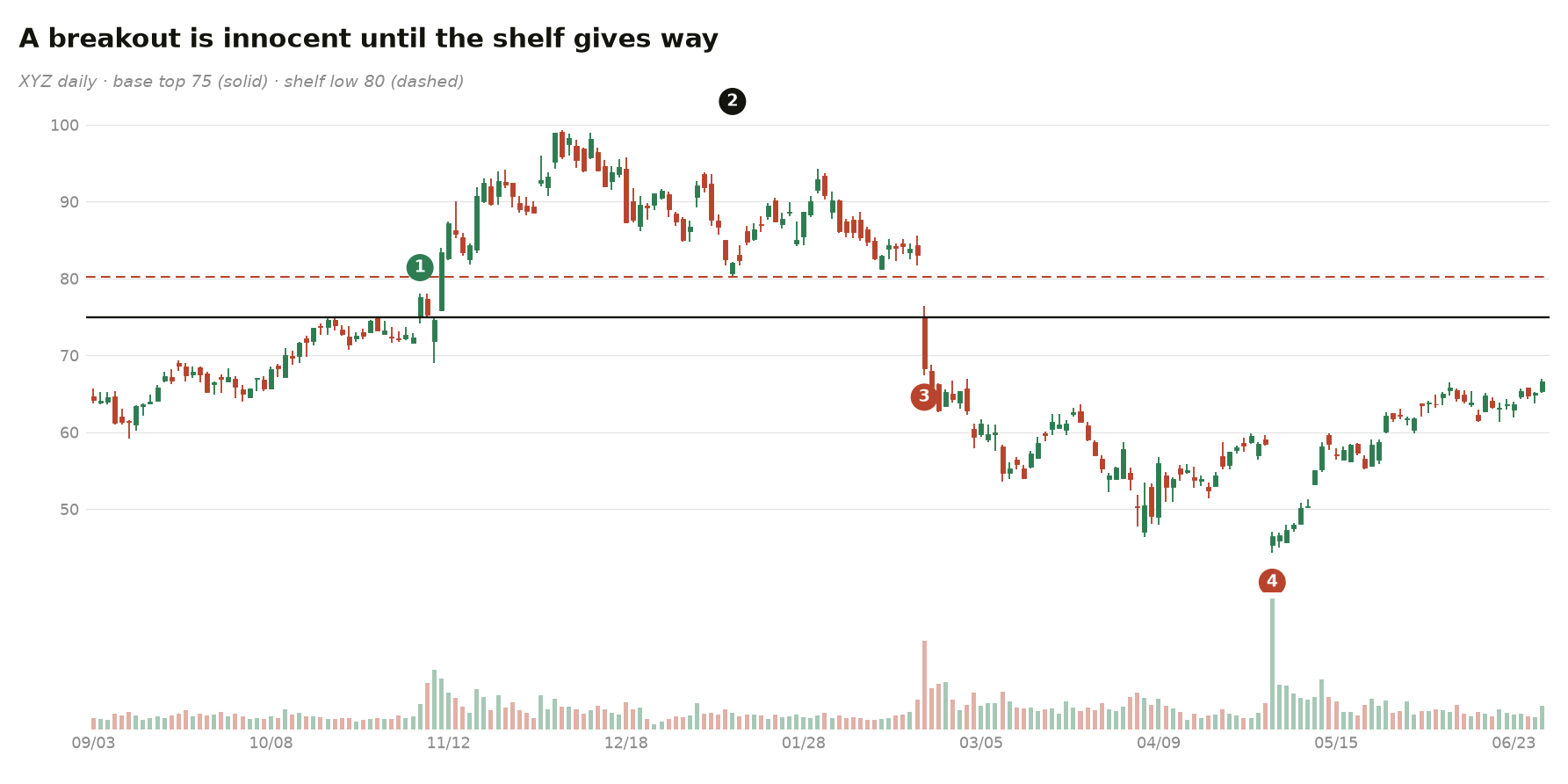
① the breakout · ② weeks of shelf · ③ the shelf gives way — the failure · ④ what failure costs
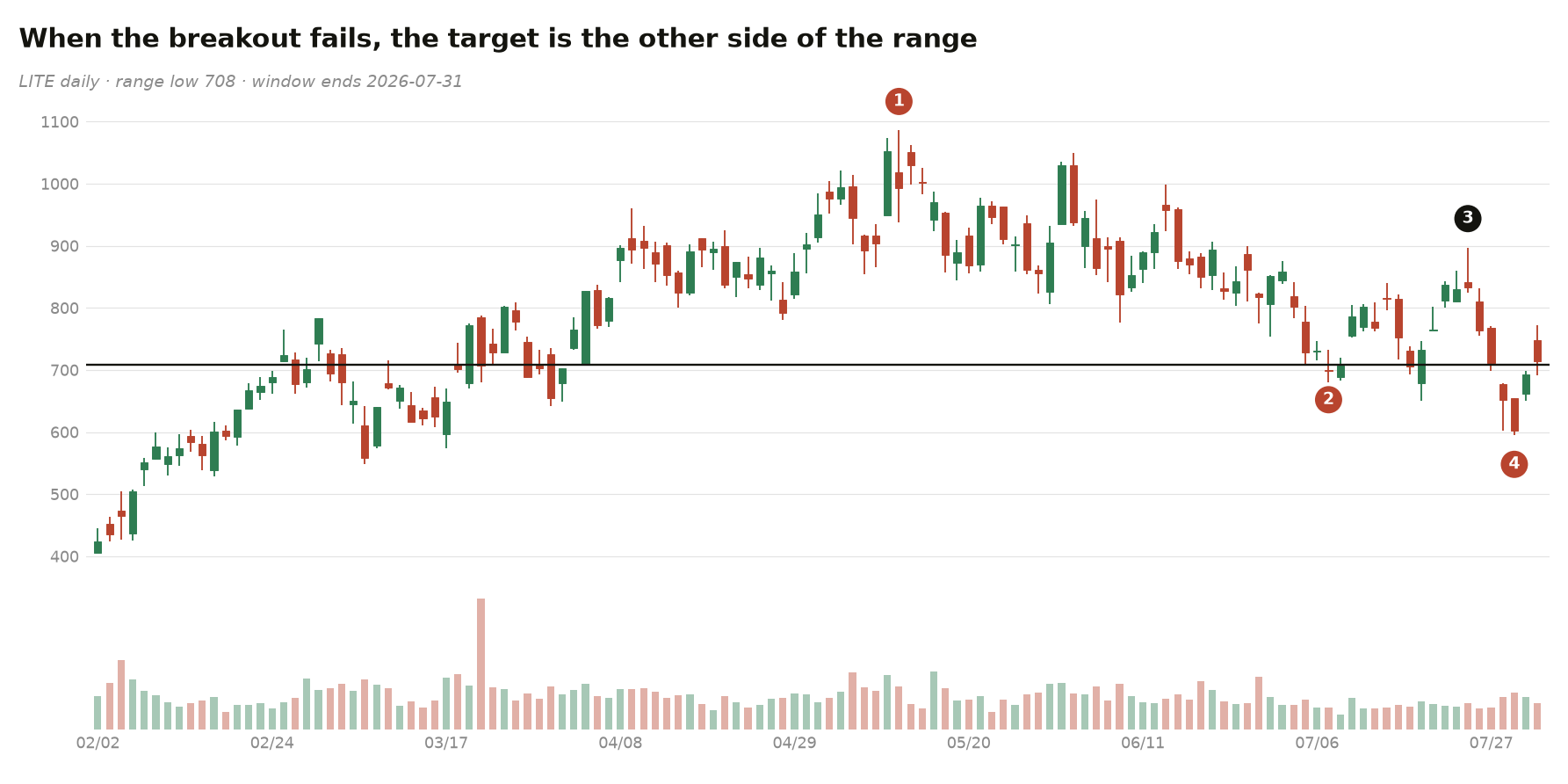
① the pushes at the highs get sold · ② the close below the range · ③ July 23: one last push dies as an upper wick — L1's failed attack · ④ a four-month low
L3.7The Mastery Drill
Measure-the-Coil Drill
- Find 10 compressions. For each, count the contraction legs (VCP-style: is each pullback shallower?) and tag volume (drying?).
- Mark where you'd wait for the release (the edge of the coil), not where you'd guess.
- Reveal the outcome: did it expand? Did volume confirm? Did any fail back in? Journal all three.
Beginner Traps
1. Quitting the coil out of boredom — right before it fires. The most expensive impatience there is. The boring part IS the setup. 2. Guessing direction inside the coil. You react to the release; you don't predict it from inside. 3. Chasing a no-volume breakout. Expansion without volume is a suspect, not a signal.
TL;DR
- Core: quiet = loading. Candles shrink + ranges overlap + volume dries = a coiled spring. Wait for the release; don't guess inside the coil.
- Mastery: volatility mean-reverts; compression is the range-bound stalemate, expansion the return to one-way; volume is the fuel gauge; a failed breakout = expectation failure that traps the crowd (→ L4, L12).
Extended Reading (optional)
Not required. Skip until Core is reflex.
- ATR / Bollinger Band width — quant ways to measure how compressed a range is.
- Options IV crush — the same compression→expansion idea in implied volatility; quiet tape = cheap options before a move.
- Wyckoff accumulation/distribution — a structural map of what's happening inside long compressions.