This lesson has two gears. Core = what you MUST know to start today. Mastery = the deeper "why" for when you're ready. Beginners: do Core first.
Why this matters
The best place to buy is the moment the last scared seller has just sold — because then there is no one left to sell.
Fluxus: "I know this shape so well because so many stocks flash it right before they run: a dip that comes straight back. That tells you there's a bid underneath. It can't fall — so the only way left is up."
Module 1 note: This lesson uses the word "buy," but you are still training your eye to recognize the undercut-and-rally shape. No real trades yet. Exact entries, stops, and sizing come in Module 2 (Lessons 10-14, where URAR returns as a full setup). For now: recognize, drill, repeat.
Weak hands put their stops in obvious places: just under support, just under yesterday's low. Price dips just below those spots, triggers the stops, they sell in a panic — and then, with the sellers flushed out, it reverses and rallies. That flush is your entry. You are not catching a falling knife; you are buying the moment after the knife hits the floor and bounces.
Fluxus: "You know exactly which price hurts you. The market will go visit it. That's its job."
Fluxus: "The last drop before it runs isn't the failure. It's the launchpad. You have to hit the ground hard before you can leave it."
Core Mode
Everyone starts here
L4.1The shakeout: fear hands over shares
Buy the reclaim of a shakeout — the "undercut & rally." Three steps:
- Find the obvious level. A clear support (a price where price has repeatedly stopped falling) or a recent swing low (an obvious dip on the chart) that everyone can see. Stops (stop-loss orders — pre-placed automatic sell orders under a low that limit a losing trade) cluster just below it.
- Watch the undercut. Price pokes below the level — weak hands get stopped out and sell. It looks awful.
- Buy the reclaim. Price closes back above the level. The flush is done; that reclaim is your trigger. Risk = just under the undercut low.
Undercut → reclaim → enter. The scary dip is the feature, not the bug.
One trap to kill now
This is NOT bottom-fishing / catching a knife. The difference is one word: reclaim. Buying the drop while it's droppingafter it undercuts and closes back above the level is a shakeout entry. No reclaim, no trade.
One real one before anything else. SPY, August 2024: the level everyone watched, the ugly poke below it, the close back above — and the stop a few cents under the flush low. Every rule in this lesson is just this picture, written out.
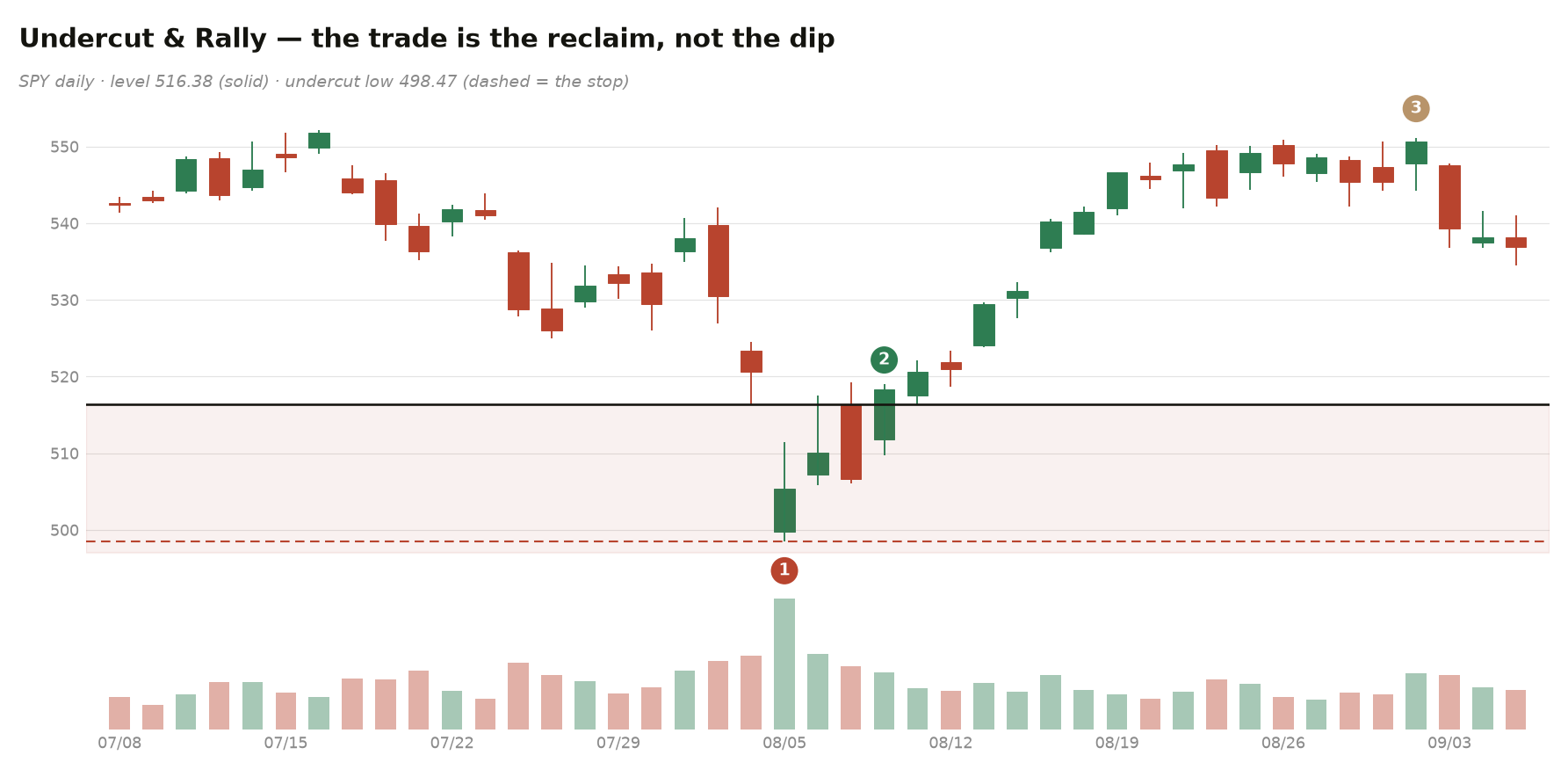
① the undercut · ② the reclaim close = the trigger · ③ what followed
L4.2The Core Drill
Shakeout-Spotting Drill
- Daily charts, indicators off. Mark obvious supports and recent swing lows.
- Hunt for the pattern: a poke below the level, then a close back above. Say out loud: "Undercut… reclaim… entry." or "Undercut, no reclaim — knife, skip."
- Start at 8 shakeouts a day, work up to 15 — for 5 days. Train yourself to want the dip instead of fearing it.
Mastery Mode
Come back when Core is reflex
L4.3Markets hunt liquidity
Stops are resting orders — pending sells sitting just below obvious lows, waiting to be filled. To a big player, that cluster is a pool of free liquidity (orders waiting to be filled — the "fuel" any big buyer needs to fill a large order without moving price too much). A dip below support is often not weakness at all — it's the market reaching down to grab the fuel it needs, then turning. Price goes to where the orders are.
This is the deepest read: the undercut-and-rally is two expectations failing back to back.
- The longs expected support to hold → it broke → they sold (expectation #1 failed).
- The shorts/breakdown-sellers then expected follow-through lower → it reclaimed instead → they're now trapped (expectation #2 failed).
- Two trapped crowds, both forced to buy back = rocket fuel. The pattern has carried two names for a century — the one-day reversal and the undercut & rally — same mechanism.
Where shakeouts live
In a range, shakeouts happen at the lows of the range (bear traps before the bounce). In an uptrend, they happen at pullback lows — the trend shakes out weak holders before continuing. Same mechanism, both phases.
The words worth keeping from this lesson live in the M1 vocabulary table — L1.4.
A real hunt, start to finish. AAPL spent February and March 2024 making obvious lows in the 167-168 area — two months of resting stops. April 19 swept them at 162, and the market spent the next three months going the other way.
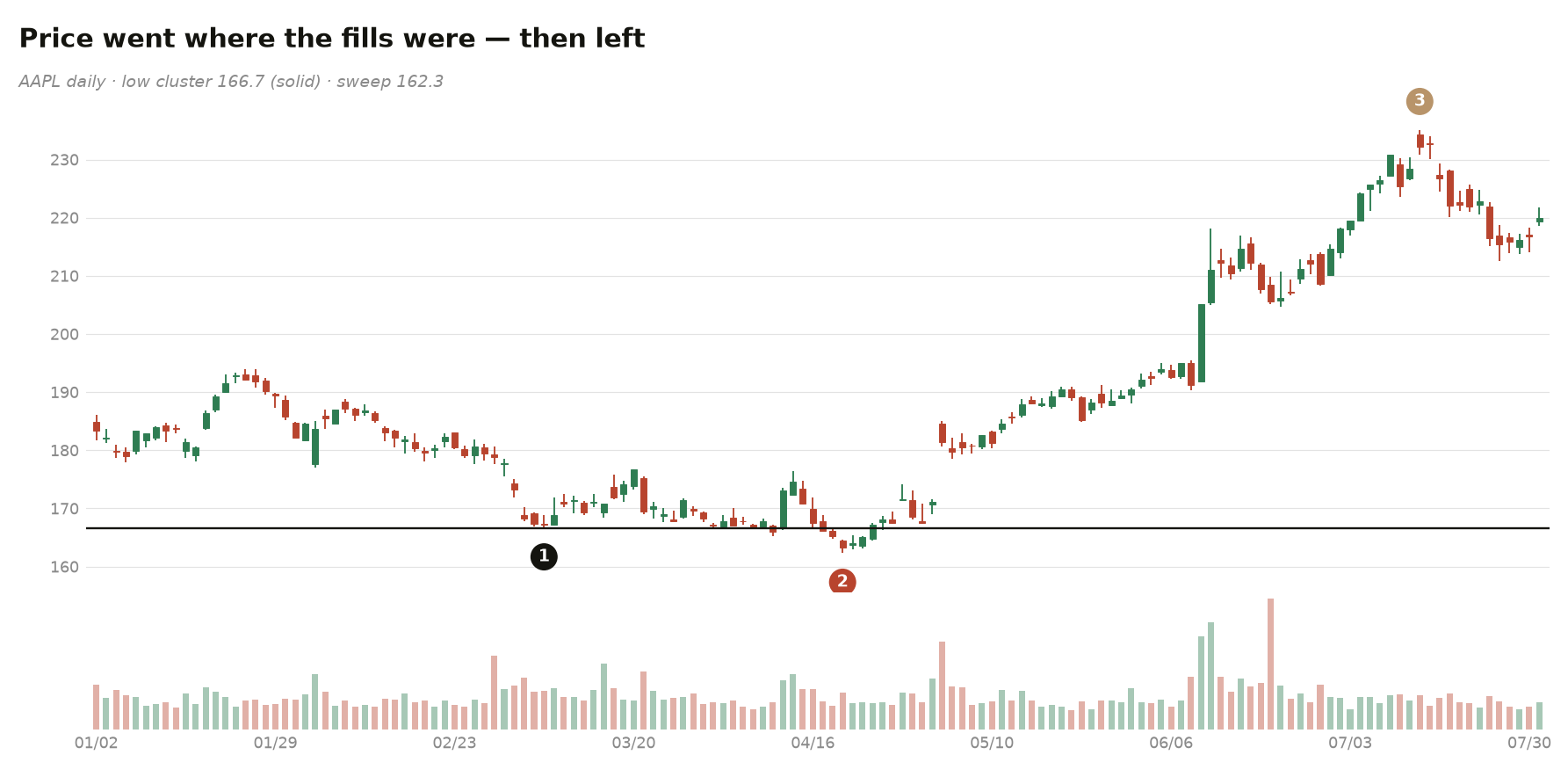
① two months of obvious lows = a pool of resting stops · ② the sweep · ③ the other direction
L4.4The reclaim is the trigger; the undercut is the risk
L4.1 gave you the trigger and the stop. What this section adds is the risk logic: the undercut already flushed the sellers, so the trade is wrong the moment that low trades again — which is what makes the stop both tight and honest.
Not a flip-flop: if you were long earlier and got stopped on the undercut, then the price reclaims and you re-buy — this is not a flip-flop, because it's a brand-new trade judged independently by L4's trigger. Flip-flop = an emotional reversal on the same trade because you were wrong. This is a new trade on new evidence.
L4.5The precise mechanical rules
Walk the SPY case with numbers, and the rules write themselves. The level was the August shelf low; the undercut poked about 3.5% below it; the reclaim close was the trigger; the stop sat just under the flush low. That is the whole machine:
- The level must be one everyone can see — an obvious swing low, not your private trendline.
- The undercut — a poke below it, typically a few percent at most. Deeper is not better; deeper is a downtrend.
- The reclaim close is the only trigger. No reclaim, no trade — ever.
- The stop goes just under the flush low. The flush already emptied the sellers; if that low trades again, the story was wrong.
Now the advanced traps — each one measured.
- "Wait for +3 above the low" (Shakeout+3) is confirmation, not a buy point. On this lesson's own chart it nearly triples the risk for the same stop. Use it to filter, never to enter.
- Entering 6% above the level is a different, worse trade — roughly three times the risk of the reclaim entry. Tight, defined risk is this setup's entire product.
- It wins about 29% of the time, median −1R, expectancy +0.59R. Low hit rate, big payoff — size for that, exit by structure.
- Of trades that reached 2R, about a third came all the way back to the stop. Not an entry problem — it is why L14B takes a third off at 2R.
L4.6Four more hunts, four different endings
The pattern is everywhere once you know it — and the rule matters most in the case where it fails.
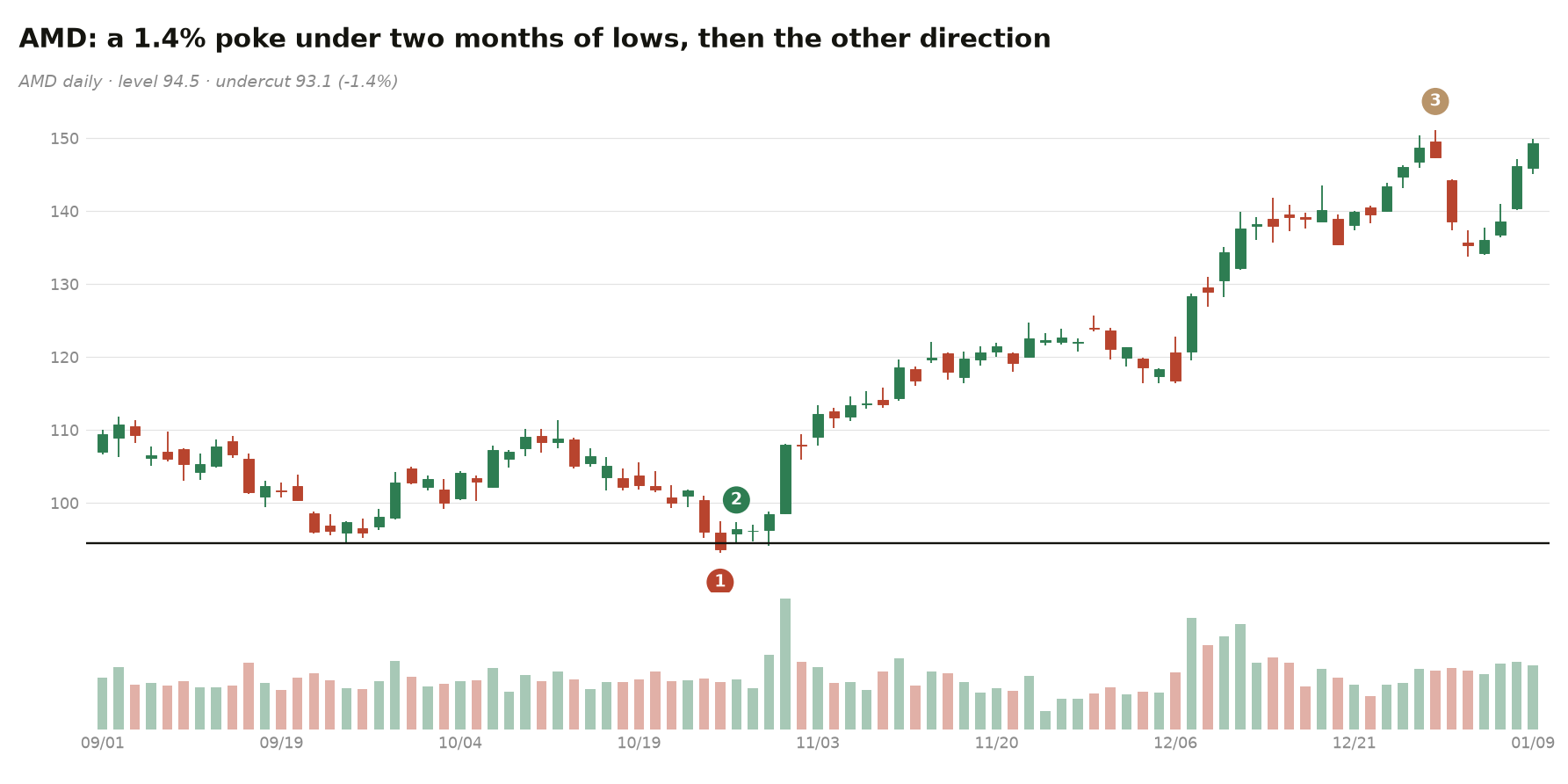
① the poke · ② the reclaim · ③ January
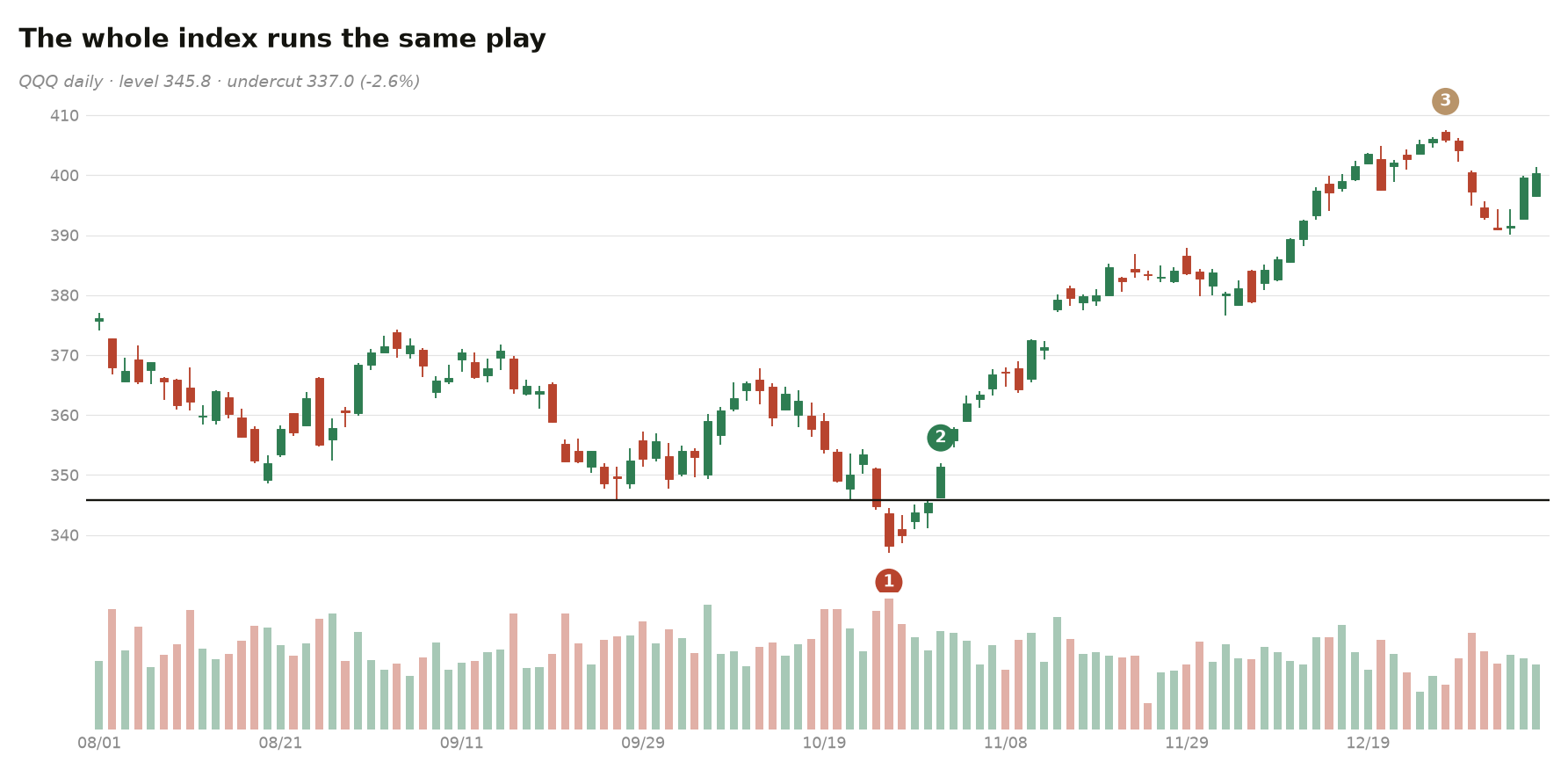
① the undercut · ② the reclaim · ③ a one-way quarter
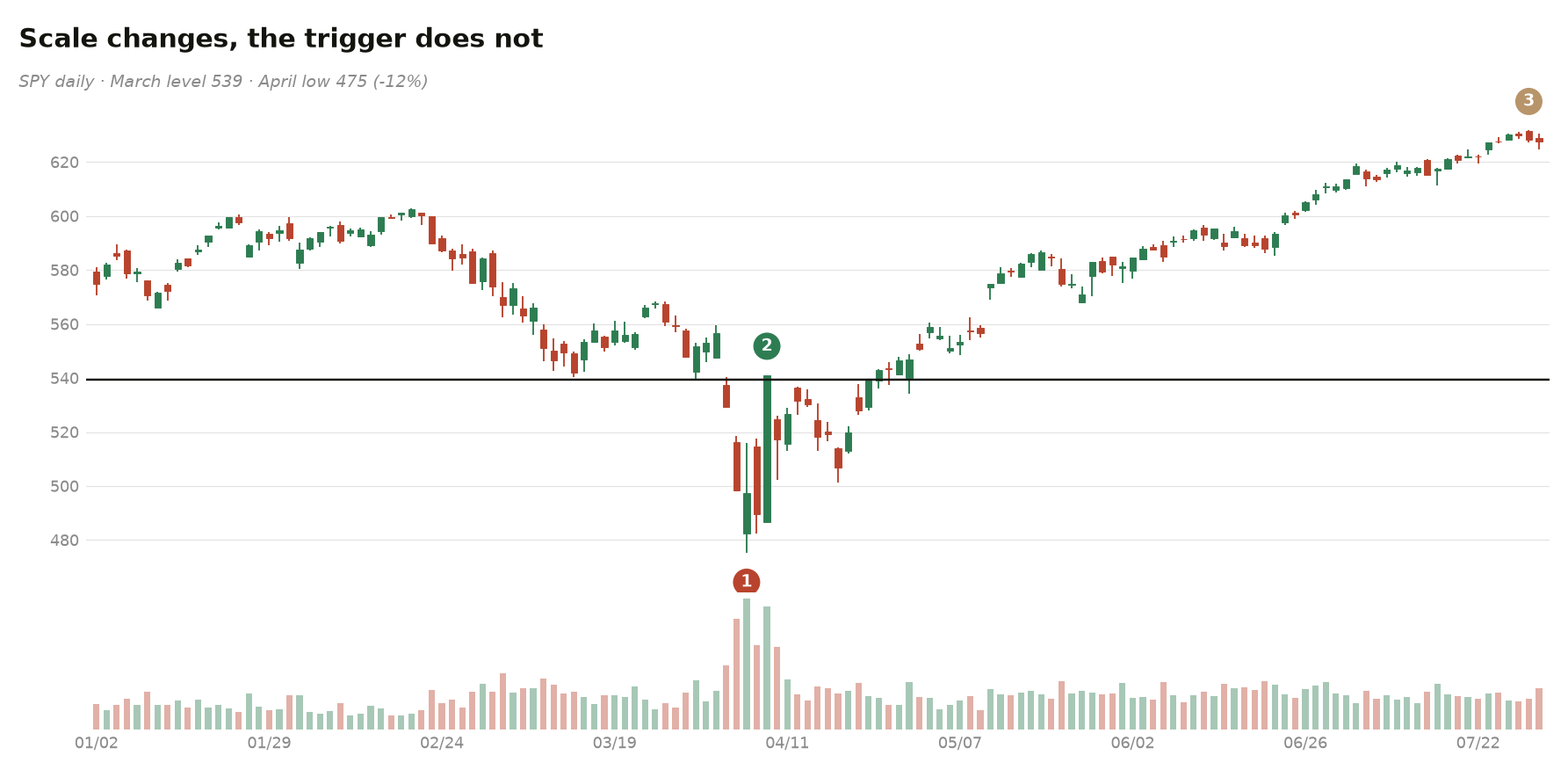
① capitulation, 12% below the level · ② the reclaim — still the only trigger · ③ repaired
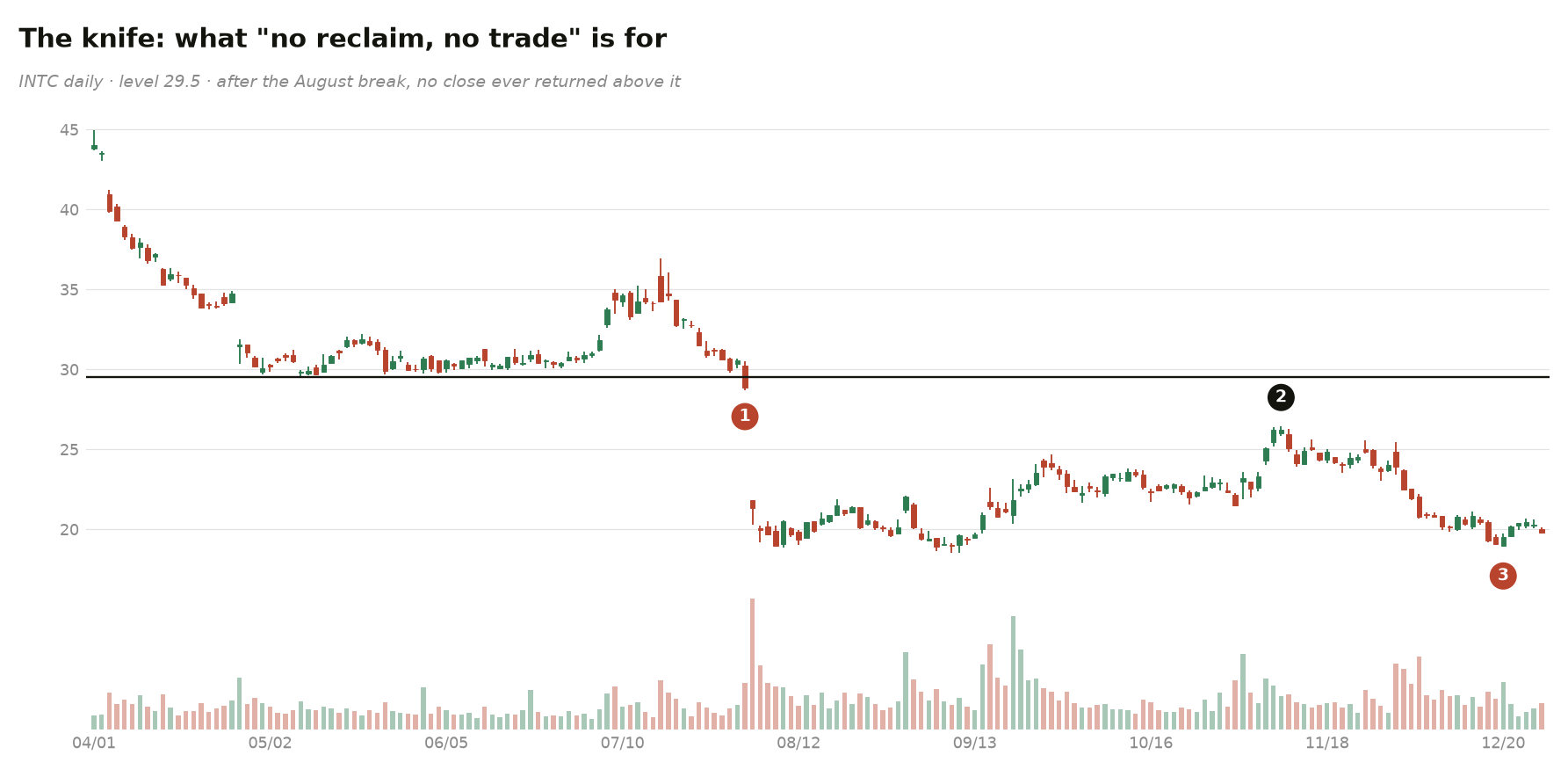
① the break · ② the rally that never closes back above · ③ lower still — the rule was the whole defence
L4.7The Mastery Drill
Reclaim Journal
- Find 12 undercut-and-rally setups. For each mark: the obvious level, where stops likely sat, the undercut low, the reclaim trigger, the risk.
- Tag whether volume spiked on the undercut (panic) and again on the reclaim (demand).
- Reveal outcome + measure: how tight was the risk vs the move that followed (the R multiple — R = one unit of risk you took; a 3R winner = you made 3× what you were risking
Beginner Traps
1. Catching the knife (no reclaim). Buying the drop mid-fall is bottom-fishing self-harm, not a shakeout entry. Wait for the close back above. 2. Buying AT the obvious level. If you buy right on everyone's stop, you become the fuel. Let the undercut happen first. 3. Moving your stop down to avoid the shake. Widening your stop so you "don't get shaken out" defeats the entire method and blows the tight risk.
TL;DR
- Core: buy the reclaim of a shakeout (undercut → reclaim → enter). No reclaim, no trade. The scary dip is the feature.
- Mastery: markets hunt resting stops; the flush transfers weak→strong hands; undercut-and-rally = double expectation failure trapping both sides; reclaim = trigger, undercut low = tight risk.
Extended Reading (optional)
Not required. Skip until Core is reflex.
- Wyckoff Spring / Upthrust — the classic structural version of a shakeout and its mirror at tops.
- Order-flow stop runs / liquidity (ICT) — watching the resting liquidity get taken in real time.
- Bridges to Lesson 12 (liquidity hunts & short climaxes) — the same idea weaponized at tops.